


Notice the texture of the lands where you are.
Welcome their unique smells, particular fragrances and scents
Their forms, colors, and shades
tones
sounds, resonances, timbres
rhythms
touch, temperature, strokes
tastes
memories
imaginations
breath.
-Yuria Celidwen, Flourishing Kin
Recently (April 2025) Naomi Klein and Astra Taylor published a terrifying and all too plausible piece in The Guardian, titled The Rise of End Times Fascism. In it they describe the overlapping visions of venture capital survivalists who are founding extra-national fiefdoms and the bunkered, resource-grabbing nationalism epitomized by Trump’s America.
Describing the goals of the venture capitalists, Klein and Taylor write, “Retooling and rebranding the old ambitions and privileges of empires, they dream of splintering governments and carving up the world into hyper-capitalist, democracy-free havens under the sole control of the supremely wealthy, protected by private mercenaries, serviced by AI robots and financed by cryptocurrencies….”
The aim is to grab and hoard what can be taken in a future defined by climate disaster and instability. “The startup country contingent is clearly foreseeing a future marked by shocks, scarcity and collapse. Their high-tech private domains are essentially fortressed escape pods, designed for the select few to take advantage of every possible luxury and opportunity for human optimization, giving them and their children an edge in an increasingly barbarous future. To put it bluntly, the most powerful people in the world are preparing for the end of the world, an end they themselves are frenetically accelerating.” What’s more, the authors claim, MAGA autocracy extends this reasoning from the private fiefdom to the nation state.
So what do we do in the face of all this “monstrous, supremacist survivalism?” Taylor and Klein see it as an opportunity for defining resistance. “To bet against the future on this scale – to bank on your bunker – is to betray, on the most basic level, our duties to one another, to the children we love, and to every other life form with whom we share a planetary home… Our task is to build a wide and deep movement, as spiritual as it is political…. A movement rooted in a steadfast commitment to one another, across our many differences and divides, and to this miraculous, singular planet.”
In that spirit, in this post I want to highlight the work of two people who in very different ways articulate visions and practices that exemplify such a steadfast commitment — not only human-to-human but rooted in participatory sensemaking with the more than human world. If you’re new to the concept, participatory sensemaking is a theory of intersubjectivity that focuses on the dynamics of relational interactions. lt looks at individual experience in relation to an emergent interaction process that takes on a life of its own in continuously determining what matters (for more on participatory sensemaking see this post). In the current post I want to extend the concept from a description of interactions between people to those that can occur between people and other beings and ecosystems.
I had already done the interviews and was planning this piece before I read the Guardian article, but Klein and Taylor’s piece emphasized the urgency for me.
“The first aspect of kin relationality is the realization of being in relation with the world or, more precisely, being the relationships in the world. Once kinship embodies us, we become the emotion, cognition, volition, and motivation of ecological belonging. Being part of a planetary system shapes our responsiveness through reciprocal care. How do we participate in ensuring the flourishing of this planetary system? By being its intentional reverential relationships, generating a sense of responsibility: the ethics of belonging.”
The primacy of Relationship
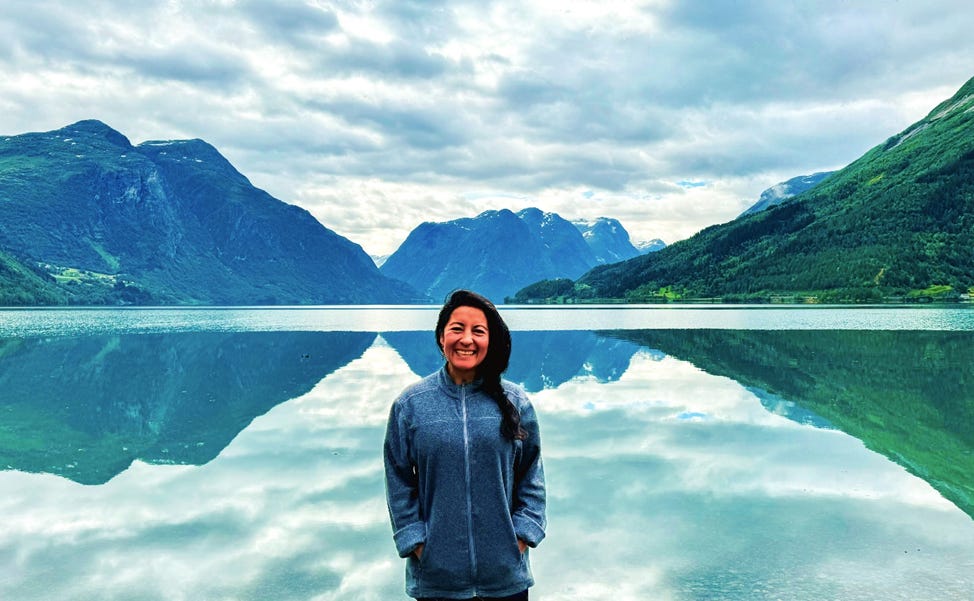
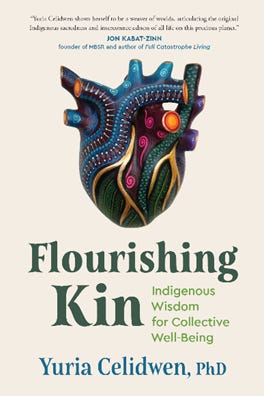
The recently published book Flourishing kin: Indigenous Wisdom for Collective Well-being, by Dr. Yuria Celidwen, provides a powerful articulation of the values of precisely the kind of spiritual and political movement Klein and Taylor describe. Last October, just before the book was published, I was lucky to meet and talk to Celidwen about her vision, which is informed by experience, practice, and scholarship across multiple disciplines. It serves as a theoretical and moral framework informed by Indigenous contemplative practices, which highlights what she calls kin relationality with the more than human world. Celidwen explains, “I try to express an idea of being kin with all of existence — with every being, with all phenomena, expanding the Western understanding of living beings from an Indigenous perspective... In this ontology of kin, we are genuinely related at the level of being with the bodies of the world, waters, forests, and skies as systems.”
This understanding of relational kinship provides the foundation of an ethics that is exactly the antithesis of end times fascism, an ethics which can ground resistance to it. Celidwen continues, “The first aspect of kin relationality is the realization of being in relation with the world or, more precisely, being the relationships in the world. Once kinship embodies us, we become the emotion, cognition, volition, and motivation of ecological belonging. Being part of a planetary system shapes our responsiveness through reciprocal care. How do we participate in ensuring the flourishing of this planetary system? By being its intentional reverential relationships, generating a sense of responsibility: the ethics of belonging.”
In Flourishing Kin Celidwen describes the moral imperative that arises from kin relationality like this: “Kin relationality demands to recognize our affiliations and our interdependence on each other and our natural environment. A spiritual binding brings together human, more-than-human, and environmental relationships through utmost respect for Mother Earth. It orients our actions toward growing communal benefit” (p. 108).
My friend Gregoire Lamoureux dedicates himself to ecological restoration projects in the Slocan Valley in the Kootenay region of eastern British Columbia. I see the way he approaches his work as being very much in keeping with the ethics Celidwen describes. To me, by quietly whispering trees and reading and restoring damaged ecosystems, Lamoureux embodies an ability to listen to the land that engenders an ethics of respect and healing.
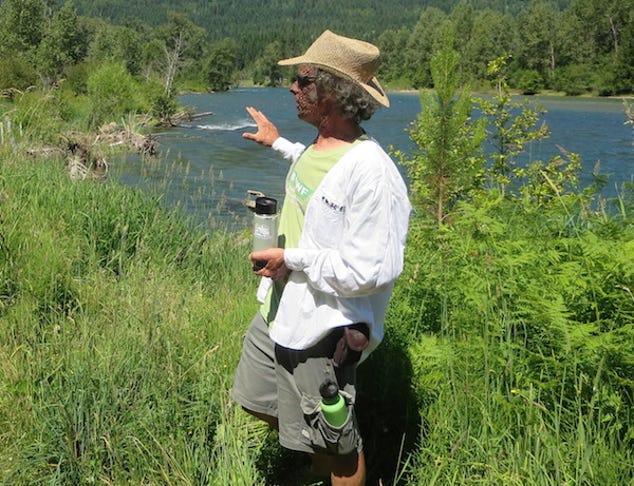
Celidwen and Lamoureux came to their complementary visions of participatory sensemaking along very different paths. Celidwen comes from Indigenous Nahua and Maya lineages from the cloud forests of Chiapas, Mexico. Her path has taken her from initial embeddedness with the land she is indigenous to, through colonial education, trauma, and immigration, to a career as a policy maker and scholar, with a PhD in cultural psychology, contemplative studies, and Indigenous studies.
She says, “I honor my ancestors of earth and bone. With that I mean my kin relational fabric with the Lands where I was born, called Coelhá, ‘the wonderlands of flowing waters,’ in the highlands of Chiapas, Mexico. My blood lineages are Maya Bats’il K’op on my father’s side and Náhua Tlaxcalteca and Ñañhu Otomi on my mother’s side. I draw from Indigenous traditions that are fundamentally place-based, from lineage to land to blood and bone.”
She was also influenced early on by “having to leave the cultural community to pursue education in colonial systems; therefore, having very early experiences of discrimination. Then, of course, fighting patriarchy. Life experiences that I had to rebel and push back against, groping to find resilience through trauma and extreme violence against my Lands, my family, and me. Moving to the US and being an Indigenous woman immigrant exacerbates those wounds.
“That keeps perpetuating narratives of doubt crawling underneath my skin, a lifelong challenge. But I persist in questioning those narratives to dismantle them — I compost my identity to regenerate it through purposeful and meaningful relationships in an intentional sense. I persevere in belonging and participating in a system that continuously insists I do not belong. These direct experiential narratives — perhaps baroque, perhaps just lyrical — that I’ve been telling you are my pushback to confirm to the world that I belong.”
Among the too-numerous-to-list mentors who guided her in her mission to find belonging, in the largest sense, she talks especially of her Elders.
“After one of my early experiences of rejection, my beautiful Grandma, whose name translates to Path of the Night Skies, brought me deep into the greenery of Coelhá. She said in the forests in the clouds in the wonderlands of flowing waters, ‘You don’t need them — all these people of hate. You have the whole forest to play with you, right here.’ Indeed, the natural world is calling for us to engage. That was one of my early lessons of contemplation: to embody being, belonging, and embracing while being embraced.
“My beautiful Abuelitos were Aj’Quijab, spiritual guides. Their teachings helped me find a remarkable close family in forestlands, although I continue to find it challenging to feel entirely comfortable in human social groups. Perhaps that’s why I made it my passion to find home, its meaning, how we create it, and how we become home to others.
“I want to emphasize that we have mentors of earth and blood. And that Ancestors are not only those who have passed, but also those to come. Our participation here, right now, is made of their actions and their guidance; thus, we are interdependent in action.”
Celidwen is currently a research scientist at the University of California, Berkeley, while on leave from her previous 20 years of humanitarian work at the UN and elsewhere. “At the UN, I was a senior editor for the landmark reports on the Sustainable Development Goals and the UN 2030 agenda. My concentration was on how the SDGs advance or recede for the world's Indigenous Peoples, the defense of Indigenous rights, and the rights of Nature. It is the continuation of the eight Millennium Development Goals that launched in 2000, now extended to 17 goals to be met by 2030 to improve life on the planet. The SDGs involve many aspects of global development through reliable institutions and multilateral partnerships. While most goals center on human development, like ending extreme poverty and hunger, ensuring health and well-being, education, gender equality, and so forth, they include ecosystem stewardship like life below water and life on the lands.”
As an academic in cultural psychology, Celidwen has worked on transcendent emotions and factors contributing to planetary flourishing. In the domain of contemplative science, which has typically focused on Buddhism and other Asian religions, she has fought hard to articulate the importance of Indigenous contemplative sciences as complementary bodies of knowledge that extend beyond a focus on the individual. It is in contrast to how contemplative practices have been primarily used in the West, she explains, where “the emphasis has been on human well-being of the individual first —achieving better sleep and concentration, even to the point that contemplation has been modified to increase the bottom line; and in the military to improve decision-making that may destroy the life of entire ecosystems. Instead, I insist that contemplative practices from Indigenous perspectives start by establishing the ethics of belonging with kin relationality and ecological belonging. The practices are spiritual technologies to become aware of the conditions of harm, reckon with them under fierce scrutiny, and dismantle them while regenerating conditions of care and responsibility. The sense of kin flourishes into belonging and reverence from a place of a woven fabric of relationships.”
She stresses that “Indigenous practices must be acknowledged as forms of science, broadening the current definition of science itself. The dominant view is limited to a very constrained set of practices, operationalizations of causal processes, media of communication, and assumptions about how the world functions. Indigenous contemplative sciences point to the broad, sophisticated systems of traditional knowledge, not only the practices themselves. These systems are equally based on rigorous observation and analysis of phenomena and how we learn from them.”
She continues, “I have pushed for epistemological equity to elevate Indigenous ways of knowing as true sciences. I’m, naturally, not imposing one or suggesting the dissolution of the other. I am bridging them to enrich our understanding of collective flourishing. Western science has achieved tremendous advancements but has failed to address place-based knowledge, context, and uncertainty. It pushes for behavior hypotheses deemed objective and able to replicate to prove universal theories, usually transactional and controlling in quality and scope...”
In Flourishing Kin, Celidwen elaborates, “Indigenous sciences explain the world through narratives, expressed in qualitative and nonlinear ways, that observe, evaluate, and document the phenomena around us. These narratives give meaning to our personal and collective responsibilities to planetary flourishing. We may delineate these narratives into four categories: oral (storytelling), embodied (ritual), collective (ceremonies), and juridical (law and governance). These groupings reflect our relational, intersubjective, and communal ways of being and contextual and place-based cultural diversity. They help us make sense of our reciprocal nature with other phenomena and their sentience, distinctness, and agency” (p. 77).
“This life tapestry is a living organism we are part of; as vessels of its impactful relationships, we make sense of its processes by moving toward flourishing or annihilation: we are the warp and weft or its unraveling. By following the ethics of belonging, we move toward participating reverentially and beneficially.”
For his part, Lamoureux’s restoration projects combine the tools of Western science — he often collaborates with biologists — with a more intuitive, experience-based approach based on long observation and apprenticeship. When he begins a restoration process, Lamoureux says, he opens the relationship with the land by taking time and listening and observing — with all of his senses. “You do a bit of an inventory — what's already there when you come to a site? — and we call that reading the landscape. So you read the landscape: How is the water — the river or the flooding — going to behave? Are there any creeks or streams? Is there any erosion on the site? What species are there? Is it just all reed canary grass, or are there still clumps of trees? Ideally, if there's a healthy part of the ecosystem you build on that. If there's already some trees, the trees will do much better planted near existing trees than out in the open.’
By way of example, Lamoureux describes his process of listening prior to starting a restoration project on an island locally known as ‘The Bird Sanctuary’ on the Slocan River: “All the trees were dead or dying, and the edge of the island was all reed canary grass, which didn't allow for new trees to grow besides a few hawthorns and a few willows. But I felt the potential again for birds, which was kind of the point of having a bird sanctuary. I thought — trees. I observed that the dead trees were falling to the ground very quickly, rotting away and falling during every storm. And there were some large stumps and a few snags leftover standing. So that taught me that this island was treed at some point. How many trees is hard to tell. It might not have been a thick forest, but there were trees here a long time ago.”
Lamoureux’s path to the banks of the Slocan River began in a Francophone household on a farm in Quebec. As a young man he became unhappy with the degree to which farming was becoming increasingly industrialized, and headed west, ending up in British Columbia. Along the way he became skilled in the theory and practice of permaculture, a form of land management inspired by ecological principles and systems thinking, and has taught permaculture courses across Canada for many years. In fact, I met him when my son took his permaculture course in Winlaw BC a few years ago. As it happened, Lamoureux had in turn been inspired by my dad, John Todd, and his work as an ecological designer creating technologies for restoration based on observation of natural processes (you can find my dad’s substack, Stories for Healing Earth, here). So Lamoureux was very excited to have my dad’s grandson in the course (he’s now a good friend to three generations of my family). At the same time, by sheer coincidence, we were in the process of closing on the purchase of eleven acres on the river in the Slocan Valley a few kilometers south of Winlaw. It turned out Lamoureux had been pruning the fruit trees there for years. He asked if he could plant some native trees along the riverbank as a strategy to slow down erosion, which had been accelerated by grazing sheep and other livestock from the previous owner. He did, my son helped, and Frog Farm became a link in a chain of properties that benefit from the restoration projects of a local non-profit organization that he co-founded, the Slocan River Streamkeepers. Lamoureux’s work now focuses on restoration, conservation and education, but in our conversation (February, 2025) we focused on the restoration projects in riparian zones.
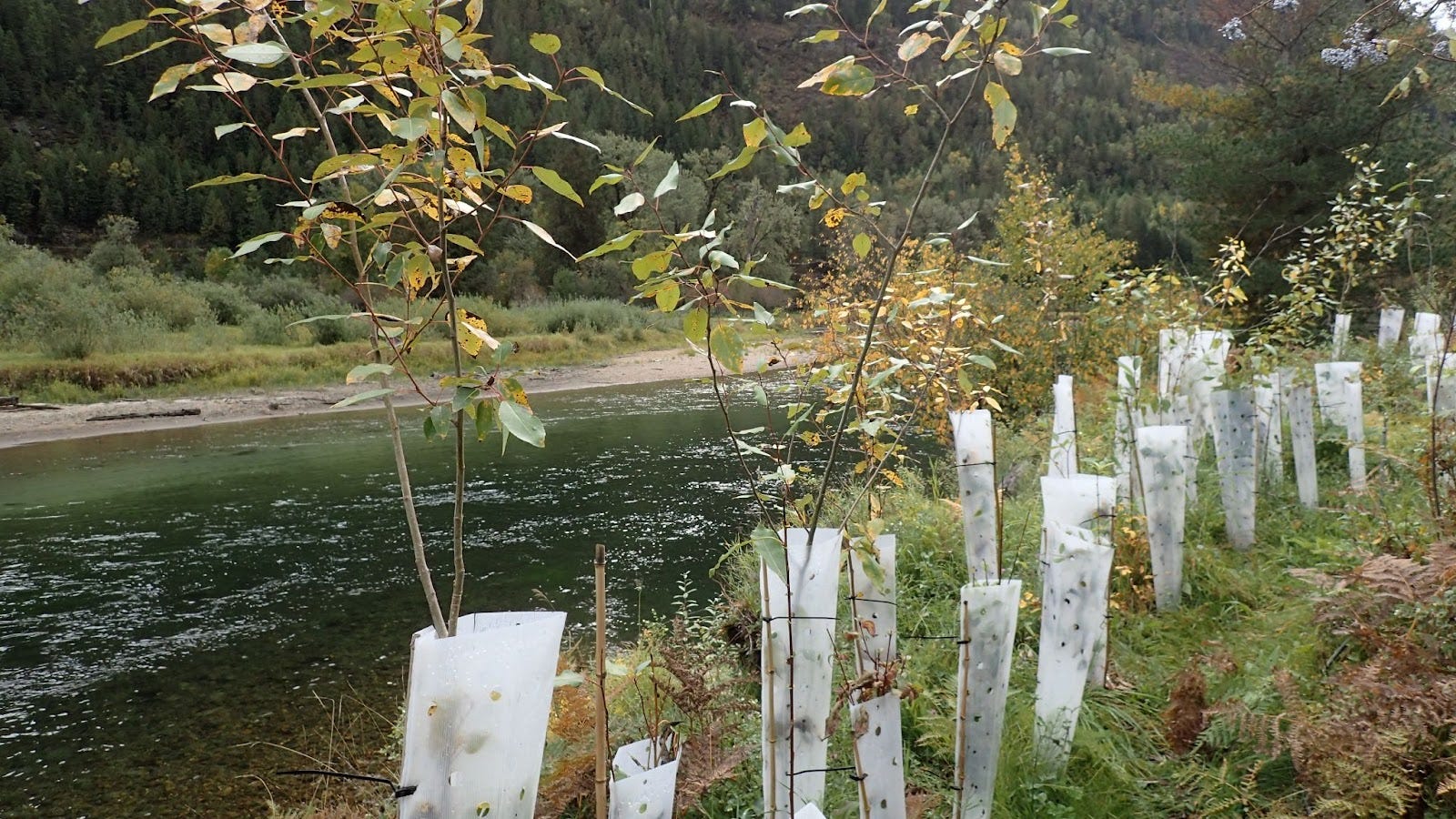
Lamoureux explains, “My understanding of a healthy riparian zone, which is a zone along the river — along any stream by the way, but along the river here — is that it includes trees in most cases. In the past those trees were very large — you’d have the western red cedar here which could live 500 years or more. You still see the stumps along the river — those stumps are often more than a meter wide. This is all gone, basically. So what we have is a mix of second-growth smaller evergreen trees, which tend to be red cedar or spruce and maybe hemlock and sometimes fir. And then you have cottonwood trees. The cottonwood is more adapted to the floodplain, so there's a lot of cottonwood — which is one of the main species we plant. Native cottonwoods and the native willow, which is more like a shrub, will also provide lots of roots along the riverbank. Once the trees are removed the grass moves in. The grass is very shallow-rooted so then the bank gets eroded, you see big clumps of sod falling into the river. We see a lot of bank erosion, especially when the trees are gone. So our approach is to try to slow that down, basically, bringing back trees and shrubs that are deeper rooted and wider rooted, such as a willow or cottonwood. And the roots will hold back soil erosion.”
“The other main reason we're doing that is for wildlife habitat. Once you remove all the trees, the birds don't have a place to nest. Some birds will nest in the grass, but most require trees — and other critters as well. So by planting a lot of trees in the long term, we'll create habitat for wildlife. Also, the trees create shade, cooling down the ground or the river. And, as the trees get bigger and start falling down in the river, they also create habitat for different critters on the ground or different fish habitats in the water — it creates shelter for them to hide from the bigger fish or other predators. So that's some of the different beneficial impacts of the work we do.”
In addition to re-planting riverbanks, Lamoureux also has been doing striking work in wetland restoration, which has been a natural extension of his style of watching and listening while working on the river banks. “It’s all connected to the riparian restoration. Usually on a property we will have a riparian planting and then, if I have time, I’ll also look and observe and understand the way the land is flowing. There's a lot of floodplain here. The floodplain is a natural process, which is fine, but what happens is you get lots of water usually here in late spring and early summer, from mid-May till almost July, and then that water disappears, it all flows downstream. So with the wetland projects we're creating shallow wetlands that hold that water so that water doesn't all flow downstream. The wetlands again create habitat because we have water there now, and you have a whole bunch of critters — creating refugia for a wide diversity of species of birds and animals and everything. And it also helps mitigate the extreme effects of climate change when we have floods and then after the flood we have a drought season. Sometimes we don't get rain from July 1st till September-October. The river still flows but it gets pretty low and the wetlands get drier and drier.
“We all need water — wildlife needs water — so we create these little oases of water and then plant life thrives. We put in nesting boxes for the birds and everything else and obviously the ducks and water birds all enjoy the wetland ecosystem. Wetlands are one of the most diverse ecosystems on the planet. So it's always interesting to see diversity evolving from what often is just a flooded field — which tends to be grass — somewhat monoculture, with a very limited amount of diversity of species. Sometimes the process is like going back in time. Historically so many wetlands around the planet were drained then filled in with soil for farming purposes or building villages and cities or housing, or industries.
“So we don't remove the industries, but we're fortunate there's a lot of land that's not occupied here. It has a lower value from a farming point of view because it floods. In one of the projects, we're interacting with an organic farm that is benefiting because as we excavate the soil to create these shallow wetlands, we're building up the soil on this farm field and its growing area. Now they're going to have a longer season to grow the crops. So it's a win-win situation.
“Also the critters we attract with wetlands tend to be the amphibians, the frogs and the toads and it also attracts dragonflies, etc. which eat a lot of insects. So that's a big benefit that we can cohabitate, have some restoration and still farm the best land, and restore the sensitive ecosystem to either riparian or wetland.“
Crooked Horn Farm Restoration Project
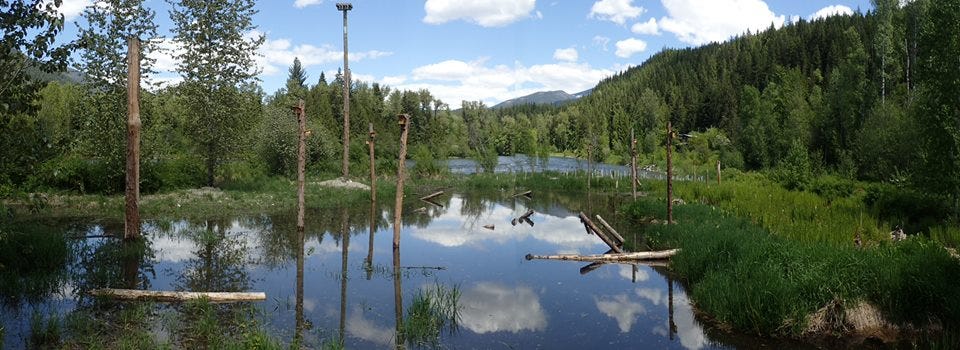
One thing that has always struck me about Lamoureux’s approach — and it’s very evident at his own small farm, Spiral Farm, in a stretch of valley called Appledale north of the town of Winlaw — is that he keeps his interventions to the minimum necessary. He has the tolerance to let natural processes have their way far beyond what most farmers will allow. He says it’s always about finding a balance between extremes. “One of the extremes is totally controlled. On most farms, the farmers want to have 100% control of what grows there. And the other extreme you might call the jungle or the wild, where everything grows where it wants to grow.
“With restoration you tend to lean a lot more toward letting things go, but you have to intervene in the early days. I look at an ecosystem and I think about ‘when’ we are in the process of succession from grasses to the shrub and the willow onwards to climax species such as cottonwood or red cedar in the floodplain. So you’ve kind of got a direction, and then because we're not landscaping somebody's front yard or property, we're not coming in with a machine to clear everything and plant our own little perfect ecosystem. I want to work with what's there, looking at what can we keep, and keeping to the principles of how little can I disturb. It’s like the concept of ecological lift. How much work we're gonna do — when there's often limited energy, or time, and money, and material — relative to how much return you get.”
Celidwen grew up exposed to Indigenous practices of learning from the natural world. In Flourishing Kin, she writes, “My ancestors infused my experiences with a relational identity that views the ecosystem as kin. In early childhood, I too listened to the rivers’ songs, sensed the jaguar leave its spotted pace upon my veins, and befriended greensome birds. I have found a very similar ethos guiding Indigenous Nations around the globe” (p. 108).
In contrast, Lamoureux grew up fully within Quebecois settler culture. So I was really curious about how he had developed his sensitivity to the systems along the river. How might young people who want to follow in his footsteps go about gaining the knowledge and skills he has?
For starters, he says, they need some basic ecological knowledge. But how to get that?
“School is one way,” he says. “Basically, programs in biology. I'm not trained in that, and I didn't go that road - I went the other road. But I work with a lot of biologists. And then the other approach is in the field, working with people with a lot of knowledge, getting paid or volunteering on projects. It doesn't have to be a formal mentorship, it can be just working on a job with somebody that has a lot of experience, that you respect, that you like the way they work.”
“And then the third way is just observing the river, walking along the banks and seeing what's going on, spending a lot of time in nature and looking at nature. So slowing down and taking time, not having your earbuds in. I often work with young people and it sometimes bothers me that we're working in nature and they have their own technological world talking to them, but that's where we are and that's fine, that's their choice. But for me, I want to have my ears and eyes wide open, especially in a place where you want to know who's coming, because in this part of the world, that critter might not always be friendly.
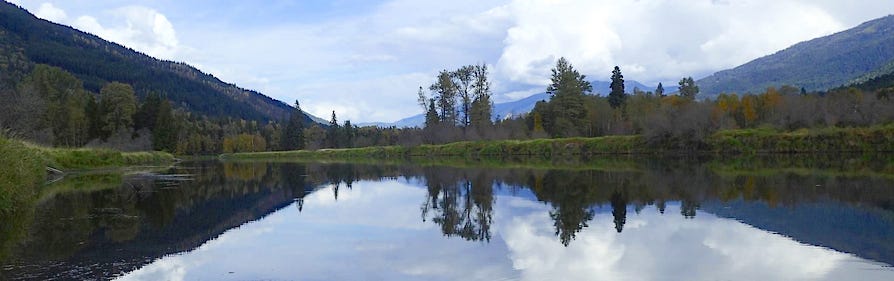
“I've also learned from mentors who look at the river in different ways. I always like to share a story where I was working with a small, but very knowledgeable-in-their-field, group. One time four or five of us, we're all walking along the river. For example, we have the fish biologist, he's looking in the river, he's seeing the trout and he can almost name each trout by name because he’s been swimming up and down the river for many years. And so he's looking at the fish through the water. Another person is more of an invertebrate person, so she's looking at the insects. I'm looking at the plants because I'm a plant person — I'm looking at the trees and shrubs on the riverbank and that kind of stuff. So we're all walking in the same place, but we're all looking at different things, and we all see what we know. Well — you see what you're familiar with, I guess, what you're looking for.
“Then, some people are a little more holistic, they have more of a whole-system approach, but those tend to be more rare people. So if you find those people that have a broad range of expertise and knowledge, you want to hang out with those people a little bit more…
There's little bits and pieces of wisdom that some people bring along the journey.”
“I want my words to be a path back to love as an ontology and epistemology of Life. To be love our way of being. To be love our way of knowing. To be love our way of learning. To be love. To be love. Love.”
Attention
Reconnection to Self, Soul, and Earth: An Indigenous Contemplative Practice
When I think about how Celidwen describes the experience of kin relationality and Lamoureux his practice of participatory sensemaking with ecosystems, it seems that those processes would require most of us to tune our habits of attention differently, to perceive differently. And I want to know how each of them conceives of or experiences attention.
For Lamoureux it’s about slowing down and taking time and really listening with all of his senses. He says, “Often in our culture we just observe with eyes. But I try to observe with all my senses. If you can use other senses to hear smell and feel — and all these other options we have — it provides a slightly different observation.”
For Celidwen, perception involves direct experience of the relational fabric, where the web of relationships is primary. “That pure, direct sensorial experience — that way of being — would be what I referred to as the kin relational network or the kin relational fabric. Just being woven in that net.” If the initial perception is of relational fabric, then the subsequent higher order categories we parse those perceptions into will be different from those outlined in cognitive psychology textbooks (as my undergraduate students have been known to point out).
“So then,” Celidwen continues, “everything that comes after kinship is necessarily rooted in: ‘Yes, we belong, we are connected, we are this colorful tapestry of Life.’”
This mode of perception is necessarily the foundation of an ethical structure. “This life tapestry is a living organism we are part of; as vessels of its impactful relationships, we make sense of its processes by moving toward flourishing or annihilation: we are the warp and weft or its unraveling. By following the ethics of belonging, we move toward participating reverentially and beneficially.”
In this way, she explains, “We are simultaneously the reason and the making of these necessarily participatory ethics. In the book, I describe eight domains that invite you to be fully in direct experience with, fully present, and fully being these ethics.”
And love. Out of all of this, within her worldview, Celidwen concludes, “I would like the one emotion and the one memory and the one experience to be sowed in the heart of the audience to be love. I want my words to be a path back to love as an ontology and epistemology of Life. To be love our way of being. To be love our way of knowing. To be love our way of learning. To be love. To be love. Love.”
Trust emerging
Life
She ripples
She hums
pulses
quivers
She sighs
murmurs
under the Skies
-Yuria Celidwen, Flourishing Kin

This was posted almost a year ago. I finally got a chance to read it. Not sure anyone will actually see this comment, but if you do,I'd love to hear your thoughts.
What hits me the hardest in this piece is that Celidwen and Lamoureux aren't offering an ideology as a counter to end times fascism so much as they're demonstrating a practice. And that distinction matters enormously right now, because the feudalist project Klein and Taylor describe is ultimately a severing: from land, from kin, from reciprocity, from any ethic of belonging that extends beyond the fortified self. When the enormity of it all collapses into helplessness, which is where so many live most of the time, the antidote to severance isn't argument; it's embodied reconnection, lived at the local scale, in relationship with specific soils, specific rivers, specific beings.
This is what the Czech philosopher Václav Benda called the parallel polis; the idea that when a dominant system becomes hostile to genuine human flourishing, the most radical and durable act of resistance is to build and sustain parallel structures of meaning, relationship, and culture. It's futile to storm the gates! We must tend what is worth preserving. Lamoureux planting willows along the Slocan isn't metaphorically resistance, it literally is. Every restored riparian zone and every wetland held back from monoculture and every child learning to read a landscape rather than consume it, my God, this is a node in a counter-polis that no billionaire bunker can replicate or replace.
And what Celidwen adds to this is the ontological foundation; the understanding that we don't just live in relationship with the more-than-human world, we are those relationships. Once that lands in the body rather than just the intellect, the ethics follow naturally. You cannot hoard what you understand yourself to be made of.
Thank you. Work like this is itself a form of restoration.